
MARKETING FOR TRAVEL AGENCIES – CASE STUDY
Digital Marketing for Travel Agencies: How Go To Paradise Reached Nearly €1M in Bookings in 8 Months

How Go To Paradise Generated Over €1M in Revenue – A Digital Marketing Case Study for Travel Agencies
This case study shows how a new travel agency can accelerate its growth when the marketing strategy reflects the way the business actually sells, rather than relying on misleading metrics. Instead of fragmented advertising and limited control over results, Go To Paradise moved to a structured model for generating enquiries and scaling sustainably.
Effective digital marketing for travel agencies requires far more than attractive visuals and occasional advertising campaigns. In the case of Go To Paradise, growth followed improvements to the tracking model, website adjustments, a clear Meta Ads strategy, and better use of existing digital assets.
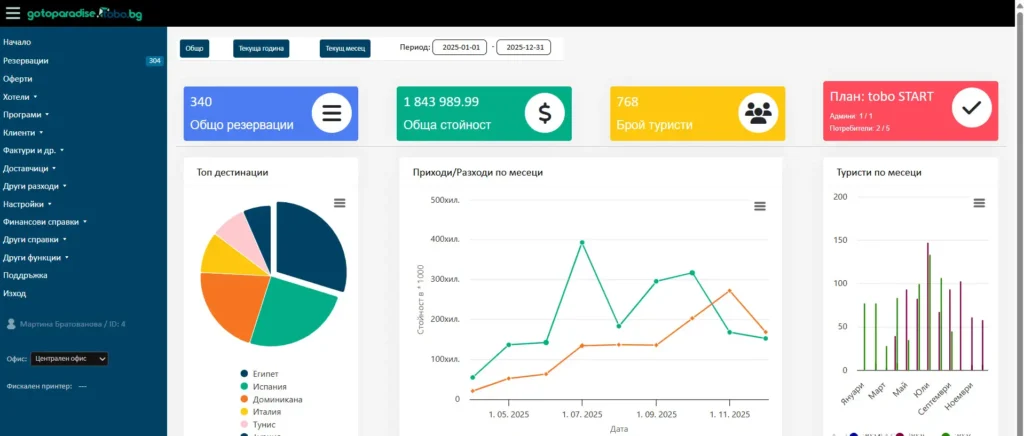
*** Note on the Financial Results
The results shown reflect the value of bookings generated in 2025. The data is based on the TOBO booking system. The value is recorded at the time each booking is created and does not depend on the actual travel date. This figure does not represent the travel agency’s net accounting revenue, nor does it depend on the invoicing model. For some bookings, the agency may recognise only its commission or margin as revenue, while other bookings may follow a different accounting model.
Results Achieved
About the Client
Go To Paradise is a relatively young travel agency as a brand, but it did not start without an existing market foundation. The company is backed by a team with many years of experience in the travel industry. Part of its customer base had already been built before the new company was established and naturally transferred to the new brand.
This is an important detail for understanding the case correctly. This was not a business starting without trust, an audience, or established credibility. It was a new company that needed an effective digital model capable of turning existing potential into stronger and more predictable growth.
At the beginning of the project, one of the partners also had existing digital assets, including a Facebook Page, Facebook Group, and Viber Group with an audience directly interested in travel. When Go To Paradise launched, these assets were rebranded under the agency’s name. This is not necessarily a universally recommended approach, but in this particular case it strengthened the brand image and accelerated the early development of trust around the new company.
The Problems
Before the marketing model was restructured, the agency had already generated approximately BGN 125K in revenue over five months. However, this result was not driven by a strong digital marketing system. It came primarily from returning customers and the existing trust in the people behind the business.
Until that point, the agency’s digital advertising was largely limited to using the Boost Post button. This is a common approach among new businesses, but it rarely creates a stable foundation for sustainable growth. The reason is simple: there is limited control over targeting, no clear optimization logic, and often no reliable way to measure real business results.
The website also required improvements. Meta Pixel and Conversions API were not implemented, while the quick enquiry form did not lead to a final URL capable of providing a reliable conversion signal.
The Objectives
The main objectives we defined were:
- Improve the tracking logic
- Optimize the website and conversion path
- Build a clear Meta Ads strategy around a limited daily budget
- Structure a funnel using different types of creatives
- Test audiences and campaign structures
- Use the existing digital assets without losing brand focus
The Strategic Approach
For Go To Paradise, we created a six-month marketing blueprint. It identified the main weaknesses on the website, problems in the existing advertising setup, opportunities for improving the conversion logic, and ways to use the available budget more efficiently.
The analysis covered several different areas. First, we reviewed the website and its conversion performance and identified the points where potential conversions were being lost. We then analysed the existing Meta Ads setup. Finally, we carried out a competitive analysis that went beyond advertising messages and included the wider market environment, economic data, competitive positioning, and advertising behaviour.
This allowed us to build a strategy around the actual business context rather than applying a generic advertising model.
Why Was Lead the Right Optimization Event Instead of Purchase?
The Main Problem in Digital Marketing for Travel Agencies
One of the biggest challenges is the mismatch between how travel websites appear to work and how the actual sale is completed.
Most websites in this sector resemble online stores. They contain offers, prices, images, packages, and booking forms, which creates the impression of a direct online purchase. In practice, however, the sale is often completed offline after confirming prices, availability, additional services, conditions, and specific dates. Payment is commonly completed by bank transfer rather than through a standard e-commerce checkout process.
This is where a major problem appears in many travel advertising accounts. The booking form is often tracked as a Purchase even though an actual transaction has not yet taken place. This distorts the reporting. Ads Manager can record a sale value that may never materialize, while still keeping it registered as revenue inside the platform.
This model can produce an attractive ROAS on paper without providing a reliable picture of advertising performance.
The Ideal Scenario
In an ideal setup, Purchase would be the correct optimization event, but only when the website functions as a complete e-commerce process. This would mean that customers can select additional services and excursions directly on the website, receive an automatically calculated final price, and pay online by card without requiring additional offline communication. In that scenario, Purchase represents a genuine transaction and provides a much cleaner optimization signal.
With a sufficiently strong advertising budget, the quick enquiry form could remain a separate Lead event, while the reservation form could be optimized for Purchase through dedicated campaigns.
Most travel businesses, however, do not operate this way. That means the correct event is not necessarily the one that looks best in a report, but the one that provides the most reliable signal about actual customer behaviour while balancing the benefits and limitations of the available setup.
Our Approach for Go To Paradise
For this type of travel website, the important question is not whether a reservation form exists, but whether submitting that form actually represents a completed purchase. In this case, it did not. The reservation was better understood as a signal of interest rather than a finalized transaction.
After discussing the sales process with the owners and analysing customer behaviour, it became clear that most actual sales were generated after customers submitted the Quick Enquiry form. The reason was straightforward. The form was shorter, easier to complete, and required less commitment at the first stage. The agency then contacted the customer and completed the sale offline.
Instead of relying on a distorted Purchase event, all thank-you pages were consolidated into a single Custom Event. This provided Meta’s algorithm with a cleaner signal and created a more realistic basis for optimization.
With a daily budget of €30, splitting the learning phase between two different final conversion events would not have been efficient. It would have fragmented the available signal and made it more difficult for the algorithm to optimize effectively.
This was an important strategic decision. It replaced convenient but misleading reporting with a more reliable model for making marketing decisions.
Execution
The first campaign focused on more affordable destinations. It had two purposes. First, it needed to begin generating enquiries. Second, it provided a testing ground for audience selection and creative strategy.
The budget was divided between two approaches:
- Classic interest-based targeting
- Advantage broad targeting
This structure allowed us to directly compare a more traditional targeting model with Meta’s broader automated targeting logic. With a limited budget, this type of testing was particularly important because it showed how effectively the algorithm could identify higher-quality audiences within the specific niche.
The creative structure was also built around the funnel:
- 2 visuals for ToF and MoF
- 1 carousel with direct offers for BoF
This created a balance between reaching new potential customers, nurturing existing interest, and presenting specific offers to users who were closer to taking action.
The first campaign generated 164 enquiries at €5.84 per enquiry. For the travel sector and the available budget, this was a strong initial signal, particularly compared with the previous fragmented advertising approach.


Shifting the Focus to Exotic Destinations
After the initial test, the focus moved primarily towards exotic destinations. This was a logical next step because these offers provided greater growth potential and higher transaction values.
The strategy did not rely on keeping one campaign running indefinitely with minor cosmetic changes. Instead, a new campaign was launched each month with new advertising visuals while maintaining the same funnel logic. This kept the advertising aligned with current offers, seasonal demand, and the specific commercial context. The structure remained consistent: two visuals for ToF and MoF and one BoF carousel with direct offers.
This consistency was important. In the travel sector, seasonality, high visual competition, and frequent comparison between offers make regular campaign updates particularly valuable. Without fresh creative, advertising can gradually lose effectiveness even when targeting remains appropriate.
The Role of Existing Digital Assets
One of the most interesting elements in this case study is the role of the company’s existing digital assets. The Facebook Page, Facebook Group, and Viber Group were not created from scratch after Go To Paradise launched. They already had audiences with a direct interest in travel.
These assets could easily have been used incorrectly if the business had relied entirely on them or remained dependent on the personal recognition of someone outside the new brand. In this case, however, they were used as an accelerator for brand image and trust during the early stage while a more structured advertising system was being developed in parallel.
This distinction is important. The successful result did not come from the existing audience alone. It came from combining established trust with a better-organized marketing system.
Expansion Through Viber
After sales began accelerating, we also launched a separate traffic campaign directing users to the Viber Group. The objective was not simply to generate more traffic, but to develop an owned channel for direct communication and promotional offers.
For travel agencies, this can be particularly effective. A Viber Group allows new offers to be distributed quickly, shortens the distance between the brand and its audience, and makes it easier to maintain interest between individual campaigns.
According to the provided data, the group grew to more than 10,000 members. The Ads Manager reports also show strong traffic performance, including more than 21,000 landing page views during one of the measured periods. This demonstrates that the channel was not merely a logical addition to the Meta strategy, but also became a meaningful asset for more direct communication with potential customers.
Selected Visuals From the Exotic Destination Campaigns:


The Business Results
The most important result in this case study is not an isolated metric inside Ads Manager. It is the overall business impact after the marketing model was restructured.
According to internal data, Go To Paradise generated approximately BGN 125K (63 813 EUR) in revenue between January and May 2025. After signing a contract with us, revenue reached approximately EUR 1M between May and December 2025. This was not simply an improvement in campaign performance. It represented a visible change in the pace of the company’s overall growth.


Why Did This Model Work?
The approach worked because it reflected the way travel agencies actually sell. Instead of optimizing around an attractive but potentially misleading ROAS, we selected a conversion signal that reflected the real sales process more accurately. Instead of relying on fragmented Boost Post campaigns, we built a clear funnel. Instead of depending entirely on new cold audiences, we also used existing digital assets with a proven interest in travel.
The combination of accurate tracking, an improved conversion path, competitive analysis, regularly refreshed creatives, and a clear budget framework created a scalable marketing model.
This is particularly important in the travel industry, where many businesses report strong vanity metrics without having a reliable connection between advertising-platform data and actual sales.
Why Is This Case Study Valuable for Other Travel Agencies?
This case is valuable because it shows not only what results were achieved, but also why the standard approach is often flawed. Many travel agencies operate websites that visually resemble e-commerce stores while the actual sale takes place through an enquiry, consultation, and offline completion. This creates a significant risk of inaccurate measurement and poor optimization decisions.
With this type of business model, choosing an honest and useful conversion event is more important than selecting a metric simply because it looks impressive in a presentation. When the data is more accurate, the advertising strategy can be developed with much greater confidence.
Who Is This Approach Suitable For?
This model is suitable for travel agencies that:
- Do not complete the entire sale directly online
- Use quick enquiries followed by direct communication
- Operate with a limited to medium daily advertising budget
- Want a more realistic understanding of advertising performance
- Need better integration between Meta Ads, their website, and additional communication channels
The approach is particularly effective for businesses that already have some form of warm audience but lack a structured mechanism for consistently converting that interest into enquiries and sales.
Conclusion
Go To Paradise is a strong example of how digital marketing for travel agencies works best when it is built around the actual sales model rather than generic e-commerce metrics. In this case, growth did not come from one individual advertisement or a randomly successful creative. It came from a structured strategy, the right conversion logic, better use of audiences, and consistent execution.
When tracking is more accurate, the website is better prepared, and the advertising is structured around a clear funnel, the results become much easier to understand and improve. This is what separates a sustainable marketing model from an isolated advertising success.
Looking for Digital Marketing for Travel Agencies That Delivers Results?
We develop marketing strategies for travel agencies that want greater clarity, more enquiries, and stronger control over real business results. When your website, advertising, and data start working together, growth becomes far more predictable.
